Access to traditional bank loans remains out of reach for millions across Southeast Asia.

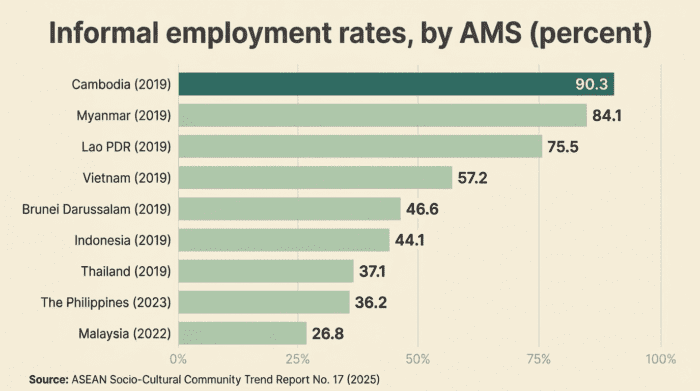
Despite the region’s rapid economic growth, most people still earn their living in the informal sector—working as day laborers, freelancers, gig workers, or small business owners. Because they lack formal payslips or credit histories, traditional banks often view them as too risky to lend to.

Percentage of population in informal employment, by ASEAN member state. Source: ASEAN Socio-Cultural Community Trend Report No. 17 (2025)
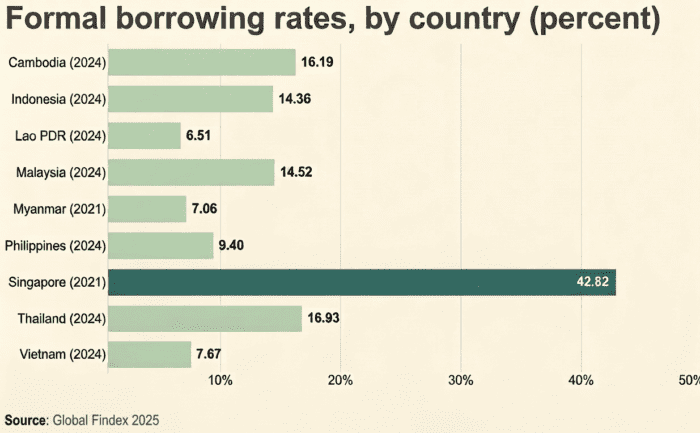
Percentage of adult population who have borrowed from banks or formal financial institutions, or used credit cards. Source: Global Findex 2025

When additional expenses arise—a medical emergency, a vehicle repair, a shop expansion, upgrading to an EV—many are forced to turn to unregulated lenders.

How Grab helps bridge the gap

Grab is in a unique position to help change this.

Through millions of micro transactions across our ecosystem, we have a view of the informal economy that traditional banks simply don’t see. We understand a driver’s daily earning capacity, a merchant’s weekly cash flow, and a consumer’s spending patterns.

By using this data responsibly, Grab Financial Services—including GrabFin, OVO, GXS Bank,  GXBank, and Superbank—can assess creditworthiness allowing  us to deliver liquidity directly to help meet users’ needs.

Impact proofpoint:

Source: Financial inclusion through lending based on platform work. Ipsos and Grab (2025), Impact Assessment of Grab’s Lending Products for Driver-Partners

As we scale financial services across Southeast Asia, we recognise that expanding access to credit brings responsibility. Here are the five core principles that guide our approach to responsible lending. 

Responsible Lending Principles

1. Inclusive Access with Responsible Guardrails 

We build financial products that seek to serve those who are often excluded by traditional banks, or new to formal credit, across Southeast Asia. That could include gig workers, micro-entrepreneurs, and consumers with limited credit history. 

Our products and services are distributed through digital channels to meet users’ everyday financing needs.

Our commitment  to fostering responsible lending   means that we embed rigorous guardrails into every stage of our lending process:

  • For driver- and merchant-partners, borrowing limits are dynamically capped as a percentage of their historical earnings.
  • For consumers, PayLater limits are personalized based on factors like how long they’ve been on the Grab platform and verified spending patterns.
  • We don’t increase lending or spending limits, or offer other new credit, to any borrower displaying repayment stress signals.

2. Clear Terms & Transparency

Every borrower should understand what they will pay, when they will pay it and what happens if they cannot pay—before deciding if they should accept a credit product. We design our credit products to be easy to understand, with fee clarity and without fine-print traps. This includes providing borrowers with information about:

  • The amount of credit offered;
  • The total repayment obligation;
  • The payment schedule and key dates;
  • All applicable fees and charges; and
  • The material consequences of missed or late payments.

We also maintain a commitment to interface design that supports transparent communication:

  • We refrain from using pre-checked boxes, hidden opt-out toggles, or confusing UI layouts.
  • When choosing to take a loan or using flexible payment options borrowers are provided with clear information at every step so that they can pick the option that best fits their specific needs.

We collect and analyze customer feedback, complaints, term comprehension and indicators of financial stress to identify where our disclosures or product journeys can be improved. 

3. Hardship Support & Ethical Recovery

We understand that unexpected events happen that can make loan repayment difficult. We believe that temporary hardship should be met with access to structured support and clear, fair procedures.

  • For driver and delivery partners, repayments are tied to active earnings. If a partner cannot drive due to illness, injury, or vehicle repair, repayments automatically pause when platform earnings stop—with zero late fees or compounding interest added.
  • Our support team assesses individual hardship requests on a case-by-case basis, offering structured extensions or modified repayment schedules.
  • During major external pressures—such as severe weather events, natural disasters, or extreme fuel price spikes—we deploy targeted relief programmes to ease the burden on affected partners.

When accounts fall into default we strive to enforce fair recovery policies:

  • We aim to adhere to ethical collection standards. Collections communication is professional, respectful, and compliant with local regulations. We have strict quality control on our collections communication to ensure the standard is maintained. 
  • If a borrower continuously defaults without engaging our hardship support, access to further credit (such as PayLater or new cash advances) is suspended to prevent over-indebtedness.
  • Unpaid credit balances do not result in punitive account bans from core earning opportunities unless there is evidence of deliberate fraud. That means a driver or merchant with an overdue loan balance will never have their platform account paused or account suspended. Partners retain their ability to earn, ensuring they have a viable path to financial recovery.
  • For consumer PayLater products, a missed payment triggers a temporary account suspension until the outstanding payment is made. Instead of compounding percentage rates, a flat admin fee is charged to reactivate the account.

4. Regulatory Compliance & Data Safeguards

We seek to build trust by adhering to local regulations and operating with integrity across every country where we offer financial services. 

  • We operate in alignment with local regulations and licensing frameworks in markets where we offer financial services.
  • We endeavour to adhere to country-specific data privacy laws. We use platform data to assess a user’s credit-worthiness for our financial services products.  This data is  never sold or shared with unauthorized third parties without prior explicit consent.

5. Pathways to Financial Growth Beyond Grab

Providing credit is only the first step toward true financial inclusion. Our ultimate goal is to help borrowers build lasting financial health—enabling them to establish credit histories that open doors both within and beyond the Grab ecosystem.

  • Many Grab partners find their first entry into formal credit through Grab Financial Services—comprising GrabFin, OVO, and our digital banks, GXS Bank, GXBank, and Superbank. We seek to turn this access into their first opportunity to build a recognized financial track record. Where feasible, we report positive repayment behavior to national credit bureaus to help them build formal credit standing that could eventually connect them to broader banking services.
  • Credit must be paired with knowledge to help our partners and users avoid debt traps. Looking ahead, we plan to leverage interactive, in-app educational modules, community-led financial literacy workshops, and personal budgeting tools tailored for gig workers, micro-merchants, and consumers to upskill them in financial literacy.

By combining accessible credit, formal recognition, and practical education, we ensure that borrowing with Grab serves as a springboard toward long-term independence and financial resilience.

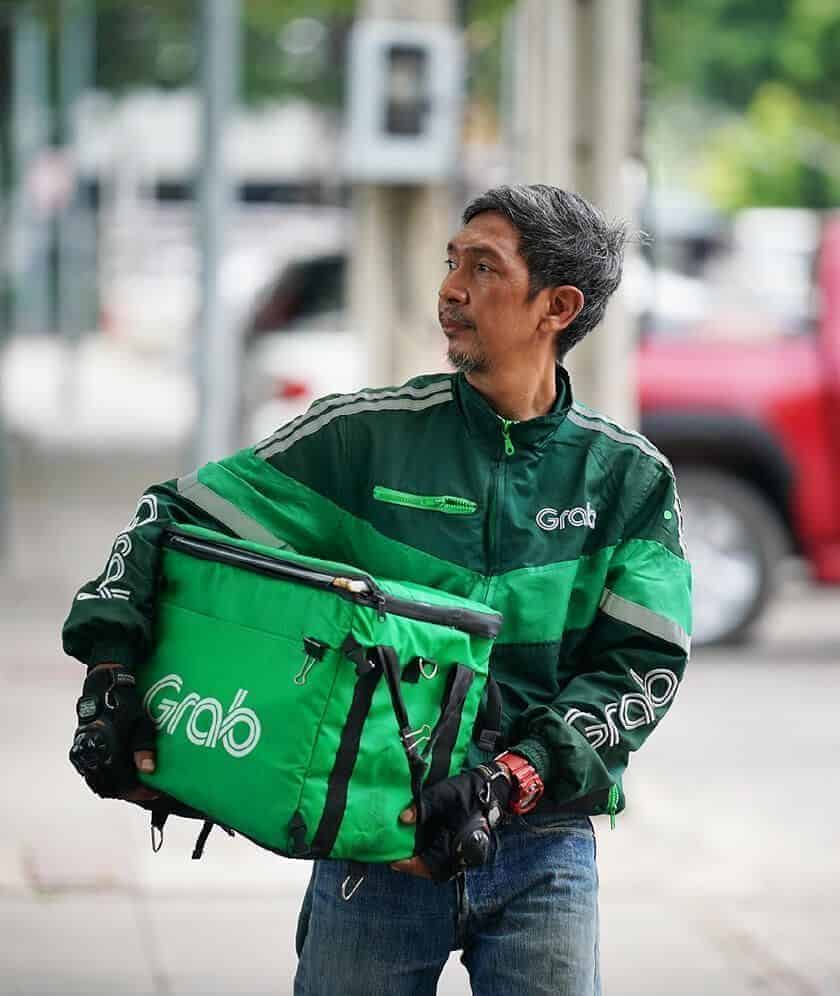
Komsan Chiyadis

GrabFood delivery-partner, Thailand

Komsan Chiyadis

GrabFood delivery-partner, Thailand

COVID-19 has dealt an unprecedented blow to the tourism industry, affecting the livelihoods of millions of workers. One of them was Komsan, an assistant chef in a luxury hotel based in the Srinakarin area.

As the number of tourists at the hotel plunged, he decided to sign up as a GrabFood delivery-partner to earn an alternative income. Soon after, the hotel ceased operations.

Komsan has viewed this change through an optimistic lens, calling it the perfect opportunity for him to embark on a fresh journey after his previous job. Aside from GrabFood deliveries, he now also picks up GrabExpress jobs. It can get tiring, having to shuttle between different locations, but Komsan finds it exciting. And mostly, he’s glad to get his income back on track.