Grab’s AI Voice Assistant empowers the visually impaired          

One of Grab’s goals is making cutting-edge AI technology accessible to underserved communities, including individuals with disabilities, the elderly, and those less familiar with technology.

We created Grab’s AI Voice Assistant to offer a more accessible way to book rides—one that’s designed with inclusivity at its core. 

While Grab’s app interface is user-friendly for most, it can be challenging for people with visual impairments who rely on their phone’s built-in accessibility tools. These tools typically read aloud app elements as users swipe through them.

But for an app like Grab that offers many services and includes interactive elements such as pop-ups and notifications, finding the right button may take time.

AI Voice Assistant allows users to simply speak their intent and get going: faster, easier, and with more independence.

Members from the Singapore Association for Visually-Handicapped (SAVH) participated in focus groups and product testing, helping us design the feature to address their needs.

Powered by AI and LLMs

AI Voice Assistant uses OpenAI’s GPT-4.1 Large Language Model and voice recognition to interact with users through voice commands. It guides users through the process of booking a ride and keeps users updated on the driver’s status, from the moment a driver is found to their arrival. Other capabilities include: 

  • Predict passenger’s drop-off & pick-off locations, while allowing them to make changes 
  • Suggest ride options to passengers
  • Provide post-booking status updates. 
  • Allow users to cancel the ride or call drivers 
  • Change payment methods, for example from cash to cashless
Building for local contexts

Creating Voice Assistant for the visually impaired requires our AI models to grasp the context and subtleties. For instance, we noticed the model struggled to recognise Singaporean accents accurately.

Built on OpenAI, we fine-tuned the speech-to-text model by training it with 80,000 local voice samples. These were contributed by Singapore-based Grabbers who recited building names, landmarks, and other phrases to improve the model’s understanding of local accents

This improved the recognition accuracy from 46 per cent to 89 per cent!

You can help us train the model

We want to further improve its accuracy, which is why we’re launching a voice donation campaign in June to invite Singapore users to contribute more voice samples.

Apart from fine-tuning our models, we had to put the feature to the test before rolling it out. Over the past few months, we have been conducting user testing among visually impaired users, with the help of SAVH. This allows us to understand their unique needs, challenges and ensure that our tool is intuitive and easy to use. 

Voice Assistant is currently being piloted in Singapore and is available to all users who have the talkback feature enabled on their phones. 

We believe that Voice Assistant is a significant step towards a more inclusive app. We will continue expanding its use cases to help more people carry out transactions, connect with loved ones, and access our services with ease.

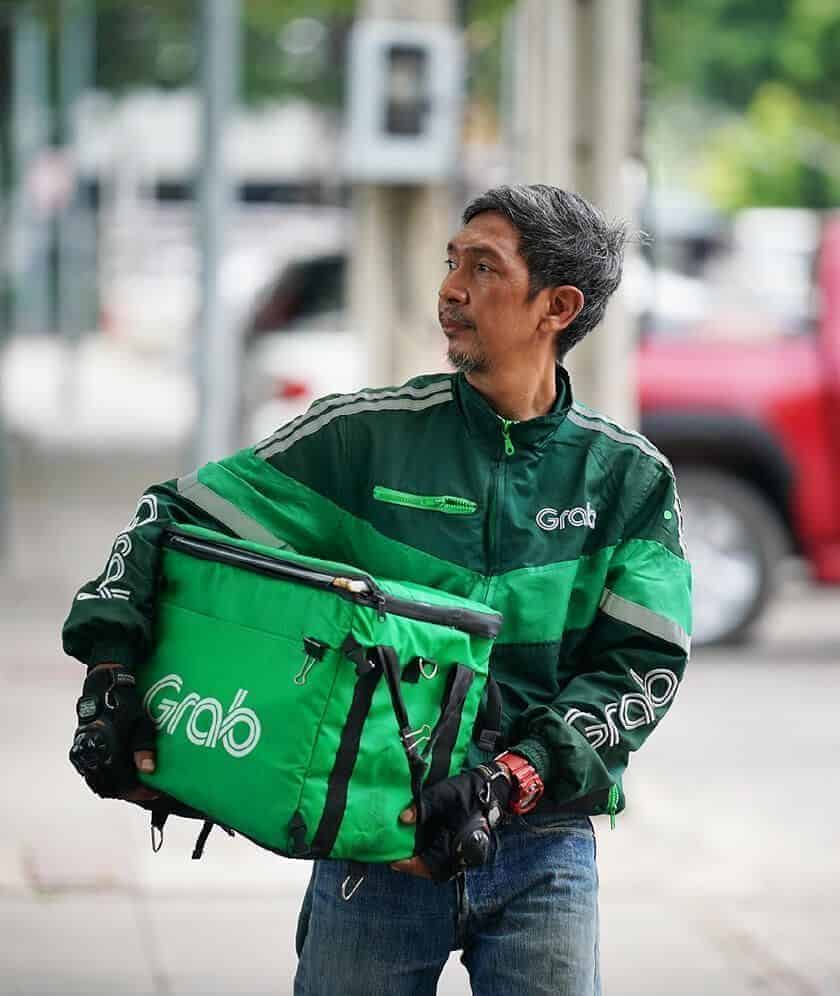
Komsan Chiyadis

GrabFood delivery-partner, Thailand

Komsan Chiyadis

GrabFood delivery-partner, Thailand

COVID-19 has dealt an unprecedented blow to the tourism industry, affecting the livelihoods of millions of workers. One of them was Komsan, an assistant chef in a luxury hotel based in the Srinakarin area.

As the number of tourists at the hotel plunged, he decided to sign up as a GrabFood delivery-partner to earn an alternative income. Soon after, the hotel ceased operations.

Komsan has viewed this change through an optimistic lens, calling it the perfect opportunity for him to embark on a fresh journey after his previous job. Aside from GrabFood deliveries, he now also picks up GrabExpress jobs. It can get tiring, having to shuttle between different locations, but Komsan finds it exciting. And mostly, he’s glad to get his income back on track.